Thursday, November 23, 2006

Catching Up

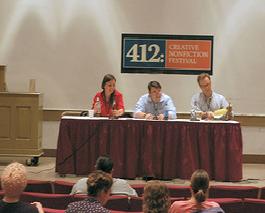
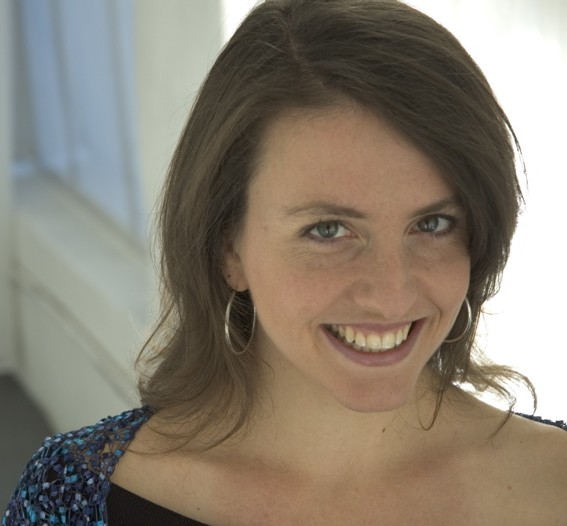
I just got back from several weeks of writing stories in hotel rooms and speaking at the 412 festival in Pittsburgh (pictured left, with Michael Rosenwald and Daniel Nester, talking about freelancing) and the Nieman Narrative Nonfiction conference in Boston, where I spoke about freelancing, writer/editor relationships, and narrative science journalism (including a panel with the wonderful Michael Pollan). The highlight of Nieman for me: hanging with Joe Sacco and Stacy Sullivan and finally getting to meet Marc Abrahams (I must hear the end of that story, Marc!)

Because of all my travels, the blog has been a bit quiet. To catch up a bit, here's a quick round-up of things I've been wanting to post about:

* A doctor in New York got the go-ahead to do the first ever womb transplant, which I find amazing: Elective organ transplantation for a non life-saving organ? No thank you.

* After a few scandals and a congressional investigation, the National Institutes of Health has finally tightened their ethics rules to restrict researchers' abilities to earn money from outside sources. As a result, a new survey says, though 73% of NIH researchers believe those new rules will increase the credibility of the organization, almost 40% say they're looking for new jobs because of the tighter restrictions.

* A group of children born as part of "Font of Life," -- the project Hitler developed to create a breed of people that fit his idea of the perfect human (blond hair, blue eyes, non-Jewish, etc) -- met for the first time as adults recently, to talk about the trauma they've experienced over their origins.

* The Chinese have admitted what experts have known for some time but haven't been able to prove: That they take organs from prisoners for transplantation, and Americans buy them on the black market.

* And a study found that elephants can recognize themselves in the mirror. How scientists figured this out is pretty fascinating, though it always frustrates me when researchers seem shocked to find that animals are just as intelligent/feeling/whatever as we are...

Labels: , , , ,

Saturday, September 09, 2006

Is She Vegetative or Conscious?

I've gotten several emails in response to yesterday's post about scientists finding brain activity in a vegetative patient ... everyone wants to know, What does it mean? Is this woman aware? Are people euthanizing conscious beings when they cut off life support for vegetative patients? The answer: No one knows. Over at "Brains," a blog run by my friend Gualtiero Piccinini, there's this interesting post by a philosopher named Pete Mandik who specializes in consciousness. He suggests what sounds like the next logical step toward understanding what these findings mean in terms of the consciousness of vegetative patients: See if anesthetized patients have similar responses. If the brains of anesthetized patients respond in the same way this vegetative woman's brain responded, Mandik says, that brain activity doesn't = consciousness. But if this woman responds in ways anesthetized patients don't, well ... that's a different story.

Labels: ,

Friday, September 08, 2006

'Vegetative' Woman's Brain Not So Vegetative

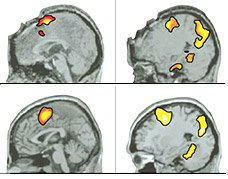
Wow, this is pretty stunning: Researchers have just done brain scans on a woman who's in a vegetative state and found that her brain responds to certain verbal cues like a healthy person's brain would. From the Washington Post:
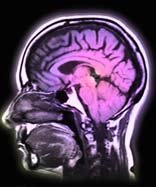
"According to all the tests, the young woman was deep in a 'vegetative state' -- completely unresponsive and unaware of her surroundings. But then a team of scientists decided to do an unprecedented experiment, employing sophisticated technology to try to peer behind the veil of her brain injury for any signs of conscious awareness.

"Without any hint that she might have a sense of what was happening, the researchers put the woman in a scanner that detects brain activity and told her that in a few minutes they would say the word "tennis," signaling her to imagine she was serving, volleying and chasing down balls. When they did, the neurologists were shocked to see her brain "light up" exactly as an uninjured person's would. It happened again and again. And the doctors got the same result when they repeatedly cued her to picture herself wandering, room to room, through her own home.

'I was absolutely stunned,' said Adrian M. Owen, a British neurologist who led the team reporting the case in today's issue of the journal Science. 'We had no idea whether she would understand our instructions. But this showed that she is aware.'
This is amazing stuff -- no question this is going to take us back to Terry Schiavo (sigh) and launch the whole how-do-you-define-brain-death debate into a whole new realm.

Labels: ,

Wednesday, August 02, 2006

Totally Nailed: Home DNA Tests Ruled a Scam

The senate hearing I posted about recently turned out to be quite interesting: The Government Accountability Office released the results of a year long investigation into at-home DNA test kits, which have minimal federal oversight or quality control, but offer actual medical advice to consumers. Their investigation showed -- beyond any doubt in my book -- that these companies are bogus:

"GAO investigators bought tests from four genetic testing Web sites, including Market America, Genelex, Sciona and Suracell. After collecting cheek swabs from an unrelated man and woman, they used the DNA samples to create profiles of 12 fictitious consumers with different age and lifestyle descriptions.

But the Web sites found different results for each profile.

'If the recommendations were truly based on genetic analysis, then the nine fictitious consumers that GAO created for these sites using the female DNA should have received the same recommendations because their DNA came from the same source. Instead, they received a variety of different recommendations, depending on their fictitious lifestyles,' the GAO report said."
These companies sent massive packets (like, 75-pages worth) of detailed information showing extensive genetic differences between each of the 12 people they thought they tested
(though there actually only tested 2), including diseases they'd be pre-disposed to, custom vitamin regimens they should take (which the companies happen to sell). The results claimed to have found "damaged genes" that would cause heart disease, diabetes, etc. Of course, at this point, there are no such gene defects: Scientists have isolated certain genes that may be connected to these diseases, but they don't know if and how these genes actually cause these problems.

You can read all the statements and see a video of the hearing here; the committee's entire massive report is here; Kathy Hudson's testimony is here, and you can check out the Federal Trade Commission's advisory against these tests here.

Since this investigation was done by a committee with no actual enforcement power, the end result of all this is a recommendation to the federal government that they require oversight of DNA testing, and a warning to consumers saying "a healthy dose of skepticism may be the best prescription," when dealing with these test results. May be? They've essentially been caught falsifying DNA results -- I'd say that warrants more than potential skepticism. I'm thinking that's grounds for full-fledged rejection. Good to keep in mind, since the companies are still operating in full force.

Labels: , , ,

Tuesday, July 25, 2006

At Home DNA Tests: Marketing Scam or Medical Breakthrough?

For those who are into this sort of thing (like me), here's some interesting news: This Thursday, July 27th, there's going to be a Senate hearing on the lack of oversight of genetic testing. It comes at the end of a year-long investigation into the safety and reliability of genetic tests offered to consumers via the Internet. The hearing is called: “At Home DNA Tests: Marketing Scam or Medical Breakthrough?” It will be at 10 a.m., July 27, in 106 Dirksen Senate Office Building. I encourage all to go (especially you journalists out there -- this is a great story I'd be all over if I weren't on a writing retreat in the middle of nowhere).

Kathy Huson, director of The Genetics and Public Policy Center at Johns Hopkins, who's been a source for several of my stories, will be testifying that a lack of oversight of genetic testing has created a situation where, “there is no way for a consumer to distinguish between the dubious and the decent” when it comes to the tests, and the labs offering them. “At best," she says, "consumers may be wasting their money” At worst, “they may be foregoing medically appropriate treatment or undertaking medically dubious treatment.”

The event will also include testimony from the Centers for Medicare and Medicaid Services and the Food and Drug Administration. And the Government Accountability Office will be releasing the results of their year-long investigation at the hearing. Should be a good time. I'll post details when they're available.

Labels: , , ,

Thursday, July 13, 2006

DNA Testing and Racial Profiling

A while ago, I posted about my wariness of using DNA testing for genealogy research --– specifically my frustration with the fact that these tests are over-hyped by the media and sold as being able to say things like, you are or aren't African-American, which simply isn't scientifically possible at this point. It's just not that simple.

Well, I just read an interesting article by Sheri Fink --a physician and journalist -- in the current issue of Discover: "“Reasonable Doubt: Questions about the forensic infallibility of DNA emerge even as police begin to use it to profile suspects by race."” Toward the end of the article, she mentions that police departments are now using the exact tests (and companies) I wrote about in my earlier post and my Popular Science article to predict the race of potential suspects based on DNA samples.

One company, DNAPrint, takes DNA samples from crime scenes and creates a hereditary profile: 60% sub-Saharan African, 37% European, and 3% Native American, for example, then sends photos of people with similar genetic makeups, so the police can have something to go by when it comes to, among other things, skin-color. Fink writes:
"DNAPrint's senior scientist Matthew Thomas rejects the charge that the company'’s test, known as DNAWitness, is itself a form of racial profiling. '‘DNAWitness will hold up to scientific scrutiny whereas personal feelings and biases won't,'’ he said."”
DNA stands up to scientific scrutiny when comparing a crime-scene sample to the DNA of an actual suspect, but using it to predict a suspect's skin color is a different story (the genetics of skin color, and the genetics of race, are far more complex than that). Apparently this doesn't matter:
"“The company has handled about 100 criminal and victim identification cases. '‘The technology can aid pretty much any case where you don'’t have a suspect but you have a biological sample,'’ Thomas says. DNAPrint has received a $50,000 subcontract to provide raw data to a National Institute of Justice grantee. "
Here's what I'm interested in (of course): When they send out those profiles of people with genetic makeups similar to the criminals, they'’re using information they've collected in a database from testing many people. I wonder if this includes the DNAPrint database, which houses genetic information from thousands of people who submitted their samples for genealogy testing. I'’d like to see the consent forms they're using for whatever databases are involved in DNAWitness: My bet is they don'’t say anything that resembles, "“Can we use your genetic information for racial profiling?"” Which is an important point: Many people wouldn't want their DNA contributing to this project, whether the science were questionable or not.

Imagine all the African Americans who've submitted DNA to the database: How would they feel about their samples being used to get black men into a line up?

Labels: ,

Friday, May 19, 2006

Screening Embryos for Cancer Genes, Anonymous Disease Donors, and Cervical Cancer Vaccine Update

Genetic testing and the controversy surrounding it got ratcheted to a new level with the news that people can now screen embryos for cancer genes. This means they can decide to abort based on the fact that their child will have an increased risk of perhaps get breast or colon or somesuch cancer someday ... Meanwhile, on the lack-of-genetic-testing front: an anonymous sperm donor passed on a rare genetic disorder to several children in Michigan

But the good news is, the cervical cancer vaccine will be approved by the FDA any minute

Labels: , ,

Thursday, April 13, 2006

Pharma Funded Studies Show Funder's Drug to be Superior!

The folks over at the Bioethics.net have a great post today reporting: "Stunning news to anyone without a brain: industry funding affects research." Check out their site for the full story.

Labels: ,

The Science and Business of DNA Diagnostic Testing

Andrew Pollack has an good story in today's New York Times that covers advances in DNA testing for diagnostic purposes -- it's becoming more and more widespread, and profitable (this is related to my cover story in this Sunday's NY Times Magazine). His story raises, once again, questions about patents, profits and science, and the impact this has on the cost and quality of the healthcare people get in exchange for their money and genetic samples (which this science depends on).

Some makers of these tests are making the argument that regulation of their products would "make it uneconomical to develop many tests, which have smaller sales than drugs. " But when there's this kind of money involved, and people are relying on these tests to decide whether they should bypass chemotherapy, somebody better make sure those tests actually do what they claim to do.

Labels: , ,

Monday, April 03, 2006

Doctors Vindicated Over Baby Experiment?

Eight years ago, two UK doctors were suspended from their posts for using an experimental treatment on babies in respiratory distress. Instead of intubating the infants (which is standard practice but can cause damage), they used something called Continuous Negative Extrathoracic Pressure (CNEP), which involved putting a box over the baby's chest to create a vacuum that helps the child expand it's lungs and draw in air. In 1998, two years after they published their research, the doctors became the focus of a governmental inquiry because parents complained that they hadn't consented to the use of experimental treatments on their children. The doctors were suspended, the investigation took years -- it uncovered problems with the trial, but the hospital challenged the parents' complaints, saying they couldn't prove they hadn't been told. Then the whole thing seemed to fade away ...

Now, according to an article in today's Independent, suddenly these doctors are "vindicated" because a study has shown that children treated with CNEP during respiratory distress do no worse -- and in some cases do better -- than children who are intubated: "Now aged 9 to 15, the children treated with CNEP had 'substantially higher' language and visual/spatial skills than those given conventional ventilation, the researchers say." The article quotes Professor Sir Alan Craft, president of the Royal College of Paediatrics, saying that this "'pioneering' research has been subjected to 'unprecedented scrutiny ... many lives have undoubtedly been saved by his research.'"

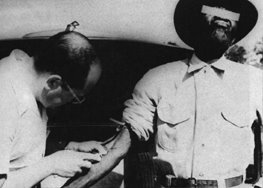
The fact that CNEP works is great news. But saying that this means the researchers are off the hook is risky logic that raises an old issue: The advance of medicine depends on doing research on humans. If you do unethical research that leads to useful results, does it excuse the research practices? Of course not. There was a huge debate about this surrounding the Tuskegee studies (pictured above) -- Tuskegee researchers uncovered a lot of potentially useful information about the clinical course of syphilis, but they did so at a terrible cost. When the trial ended and the ethical problems were uncovered, those results still existed -- some people believed the results shouldn't be cited in future syphilis research because of how the information was obtained. Others said that was silly -- we can't simply ignore the facts they uncovered. There's a huge literature on this. In the case of Tuskegee, no one talked about the researchers being vindicated because some of their results could be medically useful.

I'm not saying this CNEP study is another Tuskegee: I have no idea what really went on with this research, whether the doctors behaved ethically, or whether parent claims about lack of informed consent are accurate. I'm just sayin, it's dangerous to dismiss ethical issues because of scientific results. The only thing that settles ethical questions is further investigation into the research practices, not positive research results.

Labels:

Wednesday, March 15, 2006

More on Fake Blood and Research Ethics

A few days ago, I posted about some sketchy ethical practices in a clinical trial that's been testing fake blood without people's consent in 18 states. Well, it looks like things may get more interesting with that soon: Senator Charles Grassley has called on the FDA to tell the public (a) what's happening with this study and (b) how potential benefits of this blood substitute could outweigh the risks ... He called the trial unethical and said it never should have been approved. Grassley is accusing the FDA of disregarding their responsibility to "protect the public health," and saying the burden of opting-out shouldn't be on the public. "Equally outrageous," he said, "is the FDA's apparent failure to ensure that communities are fully aware of the risks, benefits, and nature of this experiment." I'm eager to hear their response.

For more information on all of this, see two publications from the ever-impressive American Journal of Bioethics -- their recent open letter to IRBs and their piece about race and Polyheme launched the media coverage of this issue and finally brought these questions to the public's attention. Bravo to them.

Labels: , , ,

Sunday, March 12, 2006

Fake Blood and Research Ethics

For some time now, I've been following the debate over clinical trials of a blood substitute called Polyheme, which was designed by a company called Northfield to use in trauma cases instead of human blood. To get this product out to market, it has to be tested on humans to see if it's safe and effective. The problem is, getting informed consent for that is impossible: When a person shows up hemorrhaging in an emergency room, they're in no condition to understand and consent to the potential risks of a study like this. But since the mid-90s, the FDA has allowed clinical trials of various things (including antidotes to potential biological warfare) without informed consent, if informed consent is "unfeasable" to get.

So, for the last two years -- without consent -- patients in emergency rooms around the country (including Chicago, Denver, San Diego) have been getting this blood substitute instead of real blood to test the product's effectiveness. Technically, patients can say they don't want this research done on them, but to do so they have to get and wear an opt-out bracelet, which tells people in emergency rooms that they want real blood instead. The problem is, if you want one of these bracelets, you have to know the study is happening before you go to the emergency room. Today, a Chicago Tribune article lays out some of the ethical concerns well:

"Medical ethicists and community leaders in some areas of the country where Northfield has been testing its product for the last year have said the process does not allow for enough community input. In some cases, ethicists have complained those running the trials have placed tiny legal ads in newspapers that resulted in town meetings attended by only a few people ... some critics of Northfield's trial have gone so far as to say the research protocol is racist because the testing is done in and around inner-city hospitals, and potential test subjects would have little way of knowing they could become part of a clinical trial. The San Diego Reader, a weekly newspaper, in July reported that Polyheme was being tested only on trauma patients too ill to consent in downtown San Diego and three minority neighborhoods.

In a January letter to Illinois congressional leaders, a Chicago-area surgeon involved in clinical trials, Dr. Raymond Pollak, compared Northfield's trial to the Tuskegee syphilis experiment--a 40-year clinical study in which African-American men with syphilis went untreated by government doctors. "The Tuskegee experiment ... is a painful reminder of the potential for the harm that can come from the unethical conduct of human experimental clinical trials," said Pollak, a former University of Illinois professor and current head of clinical trials at Edward Hospital in Naperville. "I believe that similar concerns have now emerged in regard to an ongoing clinical trial being conducted by Northfield Laboratories, with the tacit approval of the FDA.
The makers of Polyheme were, not surprisingly, unhappy about the recent bad press (They make a point in their press release to say that Polyheme is a promising treatment for people with sickle cell anemia, which African Americans suffer from disproportionatly -- surely an oblique (and inadequate) response to the accusations of racism and comparisons to Tuskegee?).

This case is disturbing on many levels. Of course, it's very important for science to advance, and for new therapeutics like this to be developed -- Polyheme could solve blood shortage problems and eliminate the need for blood-type-matching -- but we have endless historical examples illustrating precisely why this should only happen with full consent and disclosure to the public. There are ways to inform the communities surrounding the hospital so they (a) know this trial is happening, and (b) can exercise their legal right to opt-out if they don't want to participate (federal law mandates that all people be given that right). At this point, this doesn't seem to be happening. [It's also not clear that it will be enough if it does happen] This is precisely how we end up with Tuskegee-like problems in the first place. Which is why the researchers involved in this trial (and the FDA) should take the issue of consent very seriously and devise ways to move forward without violating people's right to not be used as research subjects.

[A side note: I've been off line lately because every waking moment (and most sleeping moments) have been consumed by a big story I just finished for the New York Times Magazine (it will be on the cover of the magazine in a few weeks -- I'll post more about it then). In the meantime, I have a huge backlog of things to post about ...]

Labels: , , ,