Saturday, May 12, 2007

New Pets Column Now Live

I'm happy to report that I am now writing a monthly column about Pets for Prevention magazine. An editor at the magazine contacted me after reading this article I wrote about my dog Bonny plus several animal-related posts on this blog -- she suggested I combine my love of animal stories with my decade of experience as a veterinary technician to write a regular series for Prevention (which I thought was a fabulous idea).

My first column just hit stands in their June issue (now available in grocery stores everywhere) -- it's called "Feeding Disorders," and it was inspired by this post about pet obesity, which I wrote when the FDA approved a crazy new diet drug for dogs (interestingly, that is one of my most widely read posts, perhaps in part because of the amazing photograph I posted with it).

Stay tuned for more columns, which I'll post here each month as they run. And feel free to email me any tips or suggestions for future columns.

Labels: , , ,

Sunday, March 25, 2007

The Dangers of Emailing, IMing, Texting, Calling ...

New studies show, yet again, that technology makes us stupid. Or at least less effective. And that the best way to accomplish something successfully -- whether it's driving a car, crossing a street, standing in a train station, or writing a book -- is to turn off the tech. I've blogged about the problems that come with constant emailing several times in the past. Now, today's New York Times reports on the newest studies into how multitasking messes with your brain:

"The human brain, with its hundred billion neurons and hundreds of trillions of synaptic connections, is a cognitive powerhouse in many ways. “But a core limitation is an inability to concentrate on two things at once,” said René Marois, a neuroscientist and director of the Human Information Processing Laboratory at Vanderbilt University.

"Mr. Marois and three other Vanderbilt researchers reported in an article last December in the journal Neuron that they used magnetic resonance imaging to pinpoint the bottleneck in the brain and to measure how much efficiency is lost when trying to handle two tasks at once. Study participants were given two tasks and were asked to respond to sounds and images. The first was to press the correct key on a computer keyboard after hearing one of eight sounds. The other task was to speak the correct vowel after seeing one of eight images."
There was no delay when participants did the tasks one at a time, but when researchers asked them to do tasks two at a time, both tasks were completed slower. This isn't surprising. What's interesting to me is that they actually pinpointed the area in the brain where this bottleneck takes place, and showed that this delay happens regardless of what multitasking you're doing, and which senses it involves. So listening to something (say, music with lyrics, or a television) while reading something causes the same bottleneck effect in the brain as trying to read two things at once. Which is very interesting. The solution, according to the Times:

"These experts have some basic advice. Check e-mail messages once an hour, at most. Listening to soothing background music while studying may improve concentration. But other distractions — most songs with lyrics, instant messaging, television shows — hamper performance. Driving while talking on a cellphone, even with a hands-free headset, is a bad idea."

No big surprise there. But still, very interesting.

Labels: , , , ,

Saturday, August 19, 2006

More Focusing Strategies from the Pros

Last week, I posted a list of strange things writers do to get themselves writing. Well, this morning, I ran across a few more for the list (subscription required for full story, scroll down to "Why I Write"):

"Emile Zola pulled the shades and composed by artificial light. Francis Bacon, we are told, knelt each day before creating his greatest works. Martin Luther could not write unless his dog was lying at his feet, while Ben Jonson needed to hear his cat purring. Marcel Proust sealed out the world by lining the walls of his study with cork. Gertrude Stein and Raymond Carver wrote in their cars, while Edmond Rostand preferred to write in his bathtub. Emily Dickinson hardly ever left her home and garden. Wallace Stevens composed poetry while walking to and from work each day at a Hartford insurance company. Alexander Pope and Jean Racine could not write without first declaiming at the top of their voices. Jack Kerouac began each night of writing by kneeling in prayer and composing by candlelight."

Labels: ,

Thursday, June 29, 2006

Tips for Successful Book Reviewing

When I launched Critical Mass, one of my fellow bloggers asked what topics or questions people wanted see us address on the site. In response to people's responses -- and the steady stream of emails the NBCC gets asking for tips on becoming a professional book critic -- Elaine Vitone and I just put together and posted a document called, "Tips for Successful Book Reviewing: Strategies for Breaking in and Staying in." It covers a range of topics: getting started as a critic, building a reviewing portfolio, going national, keeping editors happy, ethics, and more.

I posted it on Critical Mass but thought I'd post it here as well, since many readers of this blog are writers who might be interested in this sort of thing. The document is a work-in-progress: I'd love to hear thoughts, including other people's tips, and and additional questions/issues we haven't addressed but should. So please, post them here in the comments section, or on the Critical Mass post about it.

And stay tuned for more similar projects: We're now doing a series of Q&As with professional critics and review editors, where we'll tackle questions like, how does a critic pick which book to review, what's with the shrinking review sections, and more. In the meantime, check out this first installment, let us know what you think, and have a great long weekend!

##

Labels: , ,

Wednesday, April 26, 2006

Moleskine Mania

Oh no!! I, like many writers (including, at one point, Hemingway) am addicted to Moleskine notebooks. I carry several at all times: One for story ideas, another for my to-do lists and calendar type things. Plus I have one next to my bed for writing thoughts in the middle of the night, and another on my desk for taking notes during phone conversations (even with my family -- it's a hazard of my profession). They're slick, not-too-expensive, perfectly sized, sturdy ... they've gained nearly cult status among writers (and everyone else, apparently).

The owner of the company that makes Moleskines, who is now 69 years old, just announced that he's put Moleskine up for sale. He said: "Moleskine is growing very quickly and it is becoming too big for us. We do not have the capacity to follow it through."

At this point, the Moleskine is so successful, surely someone will snatch it up. That someone just better not change a damn thing about those notebooks! Just the thought of that makes me want to pull a Bruce Chatwin -- when the company that produced Moleskines went bankrupt in the 80s, Chatwin, a travel writer, ran out and bought 100 of them. Right about now, I'm tempted to do the same. My only question is, Why just 100?

Labels: ,

Monday, April 24, 2006

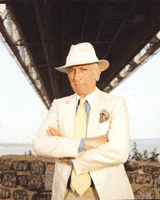
Gay Talese: Writing is Hard

There was a great little profile of Gay Talese in the NYTimes yesterday -- it nails his personality better than any profile of him I've seen. Talese is considered one of the founders of creative nonfiction (or literary journalism or narrative nonfiction or whatever you want to call it), right up there with Joseph Mitchell, Tom Wolfe, Joan Didion, and others.

It's always good to be reminded that greats like Talese are just as tortured by writing as everybody else: It usually takes him 10 - 12 years to publish a book (which makes me right on track at year 9):
"Mr. Talese, who has compared writing both to passing a kidney stone and to 'driving a truck at night without headlights, losing your way along the road and spending a decade in a ditch,' is a painfully slow worker - a tinkerer and reviser, an obsessive typer and re-typer."
All I can say is: Me too. But Talese goes much further than me in that department: "He keeps track of his progress, or lack of it, with memos and exhortations to himself that he posts on white foam panels on the wall." Things like: ""GT, what other stories - and when are you going to get back into print!?????????" Or "Where am I going???" A long time ago, I blogged about his bizarre revision practices, which sometimes involve scraps of paper and binoculars.

Talese struggles with false starts, killed magazine stories, delusions about deadline ... things any writer can relate to. About writing books, the profile quotes him saying, "The funny thing is that I never think they're going to be difficult. The Times book I thought I could do in about six months and it took me years. And maybe I should have, but I never thought this one would be so hard." Amen.

[The New York Observer had an interesting profile of him too, as does the LA Times]

Labels:

Saturday, March 18, 2006

Tips on Freelancing and Getting Published

People often contact me asking for advice on getting published, breaking in as a freelancer, coming up with story ideas, you name it. I've often told myself I'd come up with a FAQ page, or maybe even write a short book on the topic, but I've never had time. So I'm very pleased to say that Elaine Vitone, an MFA student in the University of Pittsburgh's nonfiction writing program (where I went to grad school, and where I was a visiting teacher last semester) has taken several handouts I wrote, combined them with a lengthy phone interview she did with me, and turned them into a great sort of Conversation With Rebecca Skloot. The document will be available soon as part of a guidebook for writing students in Pitt's graduate program. I'm posting it here with hopes that it will provide useful information for those who contact me seeking tips. Many thanks to Elaine for putting it together.

Labels: , , ,

Monday, January 02, 2006

On Writing: Baltimore Review Interview

I often get emails from writers asking for tips on breaking into magazine writing or making the leap to becoming a full time freelancer. I keep promising myself I'm going to put together a Frequently Asked Questions page as a resource (I actually plan to write a book about this stuff at some point), but my writing schedule has been particularly hectic lately. So, for now, I thought I'd post a link to a recent Baltimore Review interview, where writer Heather Harris asks me about writing, getting published, and more. The answers are very condensed, but some of them touch on points folks may find useful.

It starts with this hilarious (and undeniably true) first line: "Talking with Rebecca Skloot is like sticking your head out the window of a car moving at 70 miles per hour." What can I say ... I've been accused of being a fast-talking whirlwind since I was three. And riding with your head out the window is fun (see above). So I thank her for that, and for making me younger in print than I am in life -- can't complain about that.

Labels: , ,

Tuesday, May 03, 2005

On Writing: Country Roads, Take Me Home


So I’ve done it again, I’ve fled New York City for a hundred-year-old West Virginia farmhouse perched on an Appalachian foothill overlooking the Ohio River Valley. (The picture above is currently my favorite shot of the view from my writing desk.) There isn’t a phone line or internet connection in sight, which (aside from the beauty and the silence and the miles of open spaces where my dog can run and chase deer while I sit on the porch swing) is precisely why I’m here. That, and finishing my book. But those two things go hand-in-hand these days, because apparently I have to be miles from an Internet connection to actually spend an entire day writing.

I have no idea how this happened: At one point in my life, I'd get a few emails, I'd respond to a few emails, no big deal. Then a few turned in to lots which turned into hundreds, and now it’s just out of control. A friend of mine wrote an article for Time Out New York last summer about how electronic communication is ruining our ability to concentrate. The fact that he used my out-of-control-email-life as the lead to his story was probably not a good sign. A psychiatrist in London has actually done a clinical trial showing that email does more damage to a person’s concentration and IQ than smoking pot:

“emails … have an addictive, drug-like grip. Respondents' minds were all over the place as they faced new questions and challenges every time an email dropped into their inbox ... the effect ... was the equivalent, over a day, to the loss of a night's sleep.

"This is a very real and widespread phenomenon," said Glenn Wilson, a psychiatrist from King's College, London University, who carried out 80 clinical trials … The average IQ loss was measured at 10 points, more than double the four point mean fall found in studies of Cannabis users ... Dr Wilson and his colleagues found a compulsion to reply to each new message, leading to constant changes of direction which inevitably tired and slowed down the brain. In fact, it is a recipe for muddled thinking and poor performance."

I buy that completely: When I got to West Virginia almost two weeks ago, it took several days before I could just sit down and write without that weird nagging feeling like, There’s something else I should be doing right now … emails to read, emails to reply to. Writers don’t just sit and write anymore, do they? Of course they do. They just have to go to the middle of nowhere, miles away from any internet connection to do it.

A few weeks ago, during a conversation with an editor, I was talking about how hard it is to juggle a book, freelance writing, teaching, public appearances, and the many emails that result from it all. She very wisely said, “The key to life is focusing on what’s important, not what’s urgent.” The light bulb that sentence set off in my head was more like a carillon bell. This is the problem with email, and it’s the problem with writing books: An email comes in, someone asks a question, however small, and for some reason we feel we must respond within minutes, or at least days. That’s urgent. But it might not be as important as, say, the book you’ve spent the last eight years of your life trying to write. The book that may not be due in minutes or even days, but that is due in a month. I asked this editor where she came up with that brilliant phrase -- I figured she’d say something about it being a Buddhist meditation or something. But no. “A time management specialist came into the magazine,” she told me. “He sat down in my office and the first thing he said was, don’t check your email.” Then he gave her that line about the urgent and the important.

So why am I telling you this, aside from it being a good quote. I’m telling you this because, secretly, that's why I started this blog. It's my way of staying in touch with friends and family and the outside world while I'm off focusing on one very important thing: My book. It's my way of saying, please forgive me while I write my heart out and only go online a couple times a week. I hope everyone understands. Please, keep emailing me: I love reading them, and I promise I’ll respond. It just might take a little while.

Labels: , , , ,

Friday, April 08, 2005

On Writing: Driving at Night

My new favorite quote, from E.L. Doctorow:

"Writing a novel is like driving a car at night. You can see only as far as your headlights, but you can make the whole trip that way."

What more is there to say?

Labels: , , ,

Wednesday, April 06, 2005

On Writing: The Dangers of Blogging

I started writing this post as a reply to Eric, who posted a great comment to yesterday's blog (thanks Eric!). He linked to this discussion, saying I might re-think my plan to start blogging lest it interfere with my writing. His post made me laugh, especially since only moments earlier, I got this very astute note from one of my editors who read yesterday's blog: "I couldn't help but note that you left off your list of the ways a writer on deadline can distract herself one important item: start a blog."

It's true. I'm a procrastinator. This is actually what's behind the nickname Goose, which I'll get to later. Blogging can suck you in, and it can be a major procrastination tool, no doubt. But I'm also one of those writers who actually works her ideas out on paper, so for me, this blogging thing feels like it might actually be productive for my writing. Especially since I'm in the midst of a book right now, which means I can't take on any new stories, even though I have new ideas every day. I feel like blogging is a way of putting thoughts and experiences on paper for future use. I definitely hear what the person in Eric's post is saying: That once you write an idea it's gone, out there. I know a lot of writers who work that way. But I don't. My ideas are more likely to be gone if I don't write them down. My head is too full of my book right now; I have to let the other stuff out or I'll explode.

I've been working on this book for years, and I love doing it, but it's made me stifle so many things I'd otherwise write. I imagine it's a lot like trying to write with a full time job: My dad did this when I was growing up. He worked full time, raised kids, and wrote novels on the side. And he wrote any little thing he could, any chance he got -- on scraps of paper in the doctor's office waiting room, or while sitting it the car waiting to pick me up from school, or at red lights (no joke). That's how this feels to me. Right now, my book is my full time job, and I'm very very fortunate to have a full time job I love to a nearly psychotic level. But I still have all those other thoughts in my head; blogging is me getting those out at the red lights. But it's also a way of practicing my chops, getting my fingers in motion -- I find it very hard to sit down at the start of a day and just write and write and write (and write) on my book. Blogging helps get my fingers in motion, wakes up my writing voice (I used to do that with email, but because so much of my work world happens over email, I've long stopped using it as a warm up because I have so many work emails to deal with).

The key, I think, is just using the blog to vent the system -- to get a few little things out when necessary -- without letting it take over. To that end, I'm only allowing myself 15 minutes of blogging time a day. And I'm using it as a way to communicate with friends and colleagues about what's going on in my life, to cut down on my email time ... that's where the real danger lies: Email is the nemesis of my muse. I can blog for 15 minutes, but once I'm online, I can email for 6 hours and still not catch up with everything in my inbox ...

So, on that note, back to the book.

Labels: , , ,

Monday, April 04, 2005

On Writing: New New Journalism

For those who don't know, I'm in the throes of an enormous deadline for my book, which means I've been spending a lot of time pacing, dusting, writing, editing, alphabetizing my bookshelves, reading, writing, and pacing some more. In the process I've become painfully aware, once again, of the very bizarre habits I've developed over the years to trick myself into sitting down at my computer to write: Unplug the modem from the wall, step away from the desk, turn on the laptop with nothing on it but my book, type one sentence, jump up, pace around the room, walk the dog, come back, sit back down, type another sentence, maybe two or three, jump up and pace again. Repeat until writing several hundred words between paces. And that's not even the bizarre part of my ritual.

So, the other day, I saw a brand new flashy colored paperback at Barnes and Noble called "The New New Journalism: Conversations with America's Best Nonfiction Writers on Their Craft." I picked it up, saw it was full of interviews with people like Gay Talese, Ted Conover, Jane Kramer, Susan Orleans, Calvin Trillin, Lawrence Weschler ... This I had to have. So I got it, thinking, I'll use this baby when I teach, which I do from time to time, and I'll read around in it over the next few months. Yeah, right. The next night, I sat down and read through every interview in the book, word for word, in one sitting. I lingered on questions like, Is writing hard for you? What's your writing process? How do you start writing? Why do you make yourself a character in your stories? Do you ever worry about getting involved in the lives of your subjects? ...

I've spent a lot of time thinking about precisely these questions. And I tell you, I sucked this book down like it was my first dose of caffeine after a week-long withdrawal headache. Because (cliché as it may be) it reminded me of what I already know: That I'm not alone. That all writers go through this, and the answers we find to these questions help shape the books we write and make them our own. Writing is torture for most writers -- not constantly, but sometimes. In the end, we do all get our stories written. But the way we do this, well, it's just weird: Gay Talese writes his words on paper, tacks them to a wall, then crosses the room to look at them with binoculars to get a different perspective on his words. Jane Kramer has to cook for hours before she can write. Adrienne Nicole le Blanc sleeps for more than 10 hours, then gets up and start writing before she actually wakes up, so she doesn't have time to realize what she's doing, she just wakes up writing, then keeps going.

So what I'm saying is, this is a great book, and I recommend it to all readers of nonfiction, and all writers of it, regardless of whether you've won a Pulitzer or just published your first story in your neighborhood newsletter. We're all doing exactly the same thing.

Labels: , ,