Wednesday, December 31, 2008

Assistance Monkeys, Ducks, Parrots, Pigs and Ducks ... Should the law protect them? My Latest New York Times Magazine Story

Update: The Culture Dish move is now complete, and the new Culture Dish feed is now live. Please update your subscription and we'll see you over on the new site!

I know, I told you Culture Dish was moving, and it did. But I've been having problems with the new site (hard-to-read font, plus its feed isn't activated yet, alas), so I wanted to post a quick note here to let folks know about my latest New York Times Magazine story, Creature Comforts, which just went online today. It's about the use of nontraditional service animals -- including monkeys, miniature horses, parrots, snakes, goats, even ducks -- and the legal battles surrounding them. The print version will hit the stands this Sunday. I've posted about the story in detail on my new blog, along with photos of the animals I wrote about, video footage of Panda the guide miniature horse, and much more. So come check it out.

Photo caption: Skloot interviewing Richard the agoraphobia service monkey ...

Labels: , ,

Wednesday, June 06, 2007

Having a Good Pet Death

My latest pets column, The Good Good-Bye, has just hit the stands in the July issue of Prevention Magazine. As you'll see, it's about something near and dear: Dealing with the loss of a pet both emotionally, and logistically.

In my 10 years as a veterinary technician, I helped euthanize many animals, including one of my own, so I understand that side of the death experience all too well. What I didn't know until I set out to write this column was what an enormous industry pet death has become: You can get an incredible variety of pet urns and coffins (including lifesized ones), you can have your pet's hair or ashes turned into a diamond, you can cryopreserve your pet in case science catches up with science fiction to make cloning possible (don't count on that one), you can even have your pet freeze dried in a variety of natural positions, so you can keep it with you at home looking frighteningly lifelike. Okay, yeah: Some of it is definitely bizarre. But hey, like I said in my column, if this stuff helps people recover from losing pets, who cares it seems weird to others.

On another note: I've finally arrived in Memphis, where I'm surrounded by boxes and lacking an Internet connection at home. So this blog will continue to be pretty quiet for a while. But more news from The South soon ...

Labels: , ,

Saturday, May 12, 2007

New Pets Column Now Live

I'm happy to report that I am now writing a monthly column about Pets for Prevention magazine. An editor at the magazine contacted me after reading this article I wrote about my dog Bonny plus several animal-related posts on this blog -- she suggested I combine my love of animal stories with my decade of experience as a veterinary technician to write a regular series for Prevention (which I thought was a fabulous idea).

My first column just hit stands in their June issue (now available in grocery stores everywhere) -- it's called "Feeding Disorders," and it was inspired by this post about pet obesity, which I wrote when the FDA approved a crazy new diet drug for dogs (interestingly, that is one of my most widely read posts, perhaps in part because of the amazing photograph I posted with it).

Stay tuned for more columns, which I'll post here each month as they run. And feel free to email me any tips or suggestions for future columns.

Labels: , , ,

Sunday, January 07, 2007

Cuteoverload

Yes, it's true ... I, like thousands of other sensible people out there, am completely addicted to Cuteoverload. And I'm not ashamed to admit it.

But it's not like I haven't gone very public with animal obsession several times already ... sometimes quite aggressively.

Labels: , , ,

Thursday, January 04, 2007

Why is it So Damn Hard to Change?

This month's O, Oprah Magazine just hit the stands with my article, "Why is it So Damn Hard to Change," which looks at the neurology behind why it's so friggin hard to break old habits and pick up new ones (just in time for all those New Year's Resolutions). The story explores the workings of the human brain when it comes to exercising and dieting, quitting smoking, drinking, drugs, gambling ... you name it. I had a great time with it.

If you've read the story and came looking for a follow up ... well ... let's just say, it hasn't exactly been rollerblading weather in New York City lately. But I'm about to join a gym ... stay tuned for progress reports on what my dopamine system thinks of that idea.

Labels: , ,

Sunday, December 10, 2006

2006 Year in Ideas

Today's New York Times Magazine published four stories of mine as part of their annual Year in Ideas issue -- a catalogue of interesting ideas from 2006. The stories are short, but oh so much fun:

Celebrity Narcissism: A new study, by Drew Pinsky (of LoveLine fame) and Mark Young, found that celebrities are nearly 20% more narcissistic than the general public, which probably doesn't mean what you think it means.

Tushology: A scientist named David Holmes has developed an equation to examine how perfect (or not) a person's rearend is (the story ran with the above illustration, which I think is brilliant -- in case you can't tell, each of those colored lines in the drawing is a strip of measuring tape)

The Ballot That's Also a Lottery Ticket: Mark Osterloh wants to increase voter turnout by offering a million dollar incentive to show up at the polls.

Publication Probity: Creating the Journal of Spurious Correlations, the first social science journal devoted entirely to publishing negative results.

The assignments I get for the Year in Ideas issue are always some of my favorites -- they're light, fun, and totally fascinating. In previous years, I've covered Why Yawns are Contagious, Celebrity Teeth, Why Some Popcorn Kernels Don't Pop, Creating a Singable National Anthom, and Eyeball Jewelery.

Labels:

Thursday, July 13, 2006

Update on the Catalona Case

A quick update on the tissue ownership case of William Catalona v. Washington University, which I wrote about in detail for the New York Times Magazine, and in several posts on my blog:

Catalona and the patients, who lost the original suit, just filed their appeal. I got the documents late last night -- the patients' brief (68 pages), makes a very strong argument for overturning the ruling. I'll be posting on that in more detail -- and on Washington University's response when it comes -- very soon.

As I said in my Times article, regardless of the first ruling, this case is far from over ... I look forward to seeing what happens next.

Labels: , ,

Wednesday, June 14, 2006

Big News on the Tissue Research Front: A Congressional Investigation Into Researchers Profiting Off Tissues Without Consent

Finally, Congress weighs in on the lax regulation of human tissue research, tissue ownership, and the practice of scientists profiting off tissues donated exclusively for research -- something I reported on at length in my recent New York Times Magazine story, Taking The Least of You (which I've been posting regular updates on here and here and here).

A Congressional report was released yesterday detailing an investigation they launched into NIH's practices after they found out that a scientist at NIH had been providing tissue samples (obtained with federal tax-dollars) to a pharmaceutical company and pocketing large profits in return:
"A senior government scientist pocketed hundreds of thousands of dollars as a drug company consultant in exchange for human tissue samples that cost the federal government millions to acquire, congressional investigators said yesterday ... the National Institutes of Health's Dr. Trey Sunderland ... chief of the geriatric psychiatry branch of the National Institute for Mental Health, sent Pfizer 3,200 tubes of spinal fluid and 388 tubes of plasma collected for Alzheimer's research.

The government spent $6.4 million to obtain the 3,500 samples that showed how Alzheimer's disease progressed in 538 subjects. Pfizer paid Sunderland $285,000 in consulting fees related to the samples, investigators said. In total, Pfizer paid him more than $600,000 from 1998 to 2004 for outside consulting and speaking fees."

This is nothing new -- there's a long history of scientists doing this sort of thing. As a Pfizer representative said, ``The payments over a six-year period were reasonable and customary for an expert of Dr. Sunderland's stature, and reflect the fair-market value of his consulting services." Perhaps, but it doesn't make it right.

The problem is that common practices outpaced regulation a long long time ago. Because they were established long before tissues became the huge commodity they are today, the regulations currently governing tissue research are minimal and don't address big ethical issues. As a result, the enormous tissue repositories scientists have built up over the decades aren't set up for regulation: There's no uniformity in the way tissues are collected, stored, consented, or monitored. It's a mess that isn't going to be easy to clean up.
``NIH tells us it has no centralized inventory system that could tell the NIH director how many vials of tissues are in freezers at a particular institute," said Representative Joe Barton, Republican of Texas and House Energy and Commerce Committee chairman . ``It would really be a shame if we find out that the National Institutes of Health has more control over its paper clips and trash cans than it has over its human tissue samples."

The committee's senior Democrat, Rep. John D. Dingell, said: "NIH lacks adequate controls for human tissue samples, human subject protection and the scientific conduct of many of its senior employees. Accountability must be restored to NIH's own research programs."

This is absolutely true, but it doesn't only apply to the NIH. This is essentially universal. There is no established system for monitoring the widespread use of tissues throughout science, and there must be. It has to be set up in a way that doesn't inhibit science, but does protect the public against having their tissues and tax dollars used in ways they haven't consented to (including -- but not limited to -- personal profits for reseserchers). This is something scientists and ethicists and policy makers have been arguing about for decades.

The NIH has issued a statement saying, "We agree we need to improve the tracking of tissue samples ... We are in the process of determining the best way of doing that now." I'll be interested to see what they come up with. A while ago, their cancer institute created the Office of Biorepositories and Biospecimens to establish uniformity in the way samples are collect, consented, stored, regulated and distributed. If it's applied to the whole of NIH instead of just the cancer institute, and if it gains any enforcement power, that could help sort this problem out. But at this point, all of their guidelines are voluntary -- researchers don't have to comply with any of them -- and they're not given to all NIH investigators.

Not surprisingly, the researchers at the center of this case aren't talking, and high up officials at NIH have recommended that Sunderland (the main researcher) be fired. Clearly, what he's done is ethically wrong, and a system needs to be put in place so this common practice stops. But this isn't just about Sunderland -- this is about the overall lack of regulation and guidelines in tissues research.

In working on my article and book about this issue, I've talked to countless researchers about the ethics of tissue research. On the whole, I'm absolutely convinced that most researchers want to use tissues ethically, and that they work very hard to follow the existing guidelines. But the guidelines are incomplete, often confusing and sometimes contradictory, so researchers are left to figure this out for themselves. Hopefully this investigation will help solve this problem, though if history tells us anything, it might not.

Labels: , , ,

Tuesday, January 24, 2006

Of Note: Fish Tricks

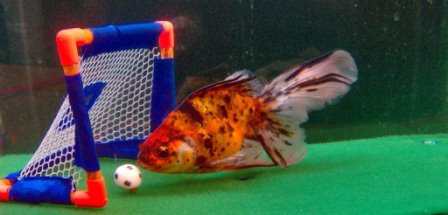
Today's Pittsburgh Post Gazette ran a story about a local man and his son who've trained their goldfish to do the limbo, play football and shoot a soccer ball into a net. The fish's owner, Dean Pomerleau, has written an e-book (called "Fish School Manual"), which he's selling through his website for the low price of $5.95, which means that you too can teach your fish to do tricks ("Money Back Guarantee"). His website is a must-see: It's got videos of fish playing soccer, dancing, you name it.

The website says, in big bold letters, "This is NOT a joke." That's right. Truth is, teaching fish to do tricks is nothing new. People have been training their goldfish for years: The first book on the subject was published in 1995, but people have been doing it far longer than that. When I was working on my story about fish medicine (and interviewing people who spend thousands of dollars taking their pet fish to the doctor), I met several people who'd taught their fish to dance, swim through hoops, swim little flips on command. As one of my favorite fish vets always says, "Fish are a lot smarter than we give them credit for."

Labels: , , ,

Sunday, December 11, 2005

On Writing: Contagious Yawning (and celebrity Teeth and Unpopped Popcorn)

Today the New York Times Magazine published three short stories of mine as part of their annual Year in Ideas issue -- a catalogue of interesting ideas from 2005. This issue is always a blast to write for: Last year I got to write about Eyeball Jewelry and one man's quest to Make The National Anthem Singable. This year it's Why Certain Popcorn Kernels Won't Pop, and People Who Want celebrities' Teeth and Why Yawning is Contagious.

The yawning story, which was probably the most interesting one, had to be short for space reasons, so there was a lot I couldn't go into: The scientist I wrote about, Steve Platek, is actually interested in using contagious yawning to study the evolution of human consciousness, which is completely fascinating and at points mind-boggling abstract.

Platek, as the story explains, has found that contagious yawning has to do with empathy: The more empathetic you are, the more likely you are to relate to a yawner and experience a yawn yourself. The way this relates to consciousness is almost counter intuitive: The neural pathways involved in empathy are the same pathways involved in self-awareness, because we empathize with people by tapping into our own experiences. Self-awareness gives us a reference point for empathizing with people: You fall down on the sidewalk and get embarrassed, and I feel embarrassed for you because my brain remembers a time when I felt the same.

Yawning exists in all living creatures: Insects, fish, birds, reptiles, mammals, you name it. But contagious yawning only exists (as far as scientists know) in humans and certain "higher primates" that have been shown to have "empathetic abilities." (Don't get me started on this idea that some animals are self-aware and others aren't -- I have issues with that, but I won't go into it here.) The way Platek sees it, at some point in evolution, certain brains -- specifically those of humans and some primates -- evolved a level of consciousness that allowed them to experience empathy (and therefore contagious yawns), and other brains didn't.

"In trying to understand something like the evolution of the self, of consciousness and empathy," Platek told me, "we need specific tests for it. We can't use Petri dishes and microscopes to see these things, so we have to develop creative ways of looking for evidence that they exist." Which is precisely what contagious yawning is, Platek says. It's a cue that a brain has a level of self-consciousness that makes "empathetic mechanisms" possible.

Platek and I had a great time talking about yawning. When we got to this point in the conversation I said, Wait a minute ... You're saying you can study consciousness by looking at yawning? To which he said, Yep, that's right: "Contagious yawning is a way for science to have a window into understanding the basic neural mechanism that may have given rise to the evolution of consciousness, or what we call the human condition." Then he paused.

"Whoa," I said, "that's heavy."

"I know," he whispered, laughing. "I was just thinking the same thing: It's weird. We were talking about yawning and now I'm talking about consciousness!? But that's where it all came from, so that's what happens. You talk about yawning, you end up at consciousness. "

Who knew studying yawning could be so useful. And there's more: Certain types of brain damage can cause people to suddenly lose their empathethic abilities, so contagious yawning can serve as a test to see if your brain is functioning normally. Yawning is also a very curious (and little understood) side effect of certain drugs -- especially impotence drugs, which has led one researcher to investigate the connection between sexuality and yawning. Then there's scizophrenia (as I mentioned in my last post): Platek uses people with schizophrenicenic tendencies to study contagious yawning -- since schizophreniaenia interferes with empathetic abilities, it can make people immune to contagious yawns.

Clearly, I could go on and on about yawning. And I will with a longer story soon. But until then, I'll end with this: You want evidence that yawning is contagious? Just do a google images search for "yawn" and start looking through the pictures ...

Labels: , , , ,

Saturday, October 29, 2005

On Writing: Another Pigpen Penthouse Photo

A few days ago, in response to email requests from readers of my recent New York Times story, I posted some photos of the Pigpen Penthouse. I promise, won't keep posting pictures, but Gary McIntire just sent me this one of the morning view from the Penthouse, and it's so amazing, I had to post it (click the image for a larger view):


Labels: , ,

Wednesday, October 26, 2005

On Writing: Bear Stew at the Pigpen Penthouse

Today, the New York Times Dining Section published a story I wrote about The Pigpen Penthouse. I absolutely loved writing this piece -- it felt like such a celebration of life and eating, and the communities we develop around food. Several readers have emailed asking where they can find more information about the Pigpen Penthouse, including photos, and asking how in the world I stumbled on this place (which is a very good question). So I decided to post that information here, along with photos, which aren't available online anywhere (click on these photos for a larger image, which is the only way to really do them justice). The photo to the left shows the hog barn with the octagonal penthouse on top. It also shows the wooden deck Gary built on top of the barn (he nearly killed himself making it -- he fell 35 feet from the roof and fractured his back).

In the future, the Pigpen's owner, Gary McIntire, plans to rent the place out for parties, weddings, retreats. I can't imagine a better place for that (I imagine he'll set up a website for the place when the time comes). When I was at the Pigpen recently talking to Jeff Potts, the man who made the bear stew I wrote about (and ate) in my story, he said, "Go up on that deck, open your eyes wide, and you can see forever." He's absolutely right. This photo (right) is the hot tub on the deck, and the view beyond.


I first found Gary while doing research for my NY Times Magazine article on Baristas, a pub and cafe in a nearby West Virginia town. I spent a wonderful day at the Pigpen talking to Gary about local food, The Pigpen, and what he hoped to do with it. He only made a one-sentence appearance in the Baristas story, but at that point, I knew I'd write a whole story about him someday (I often stumble on my best stories while doing research for other pieces). In the following months, my boyfriend David and I visited the Penthouse as guest chefs ... We made beet soup using fresh beets from the garden; I made my infamous Caesar salad (with real anchovies and coddled egg, none of that creamy Caesar stuff). David made his unbelievable grilled pizza, and we ate at this table (above) on the deck, with the most incredible wine, and view. It simply doesn't get much better than that.

Labels: , ,

Wednesday, October 12, 2005

Fish Medicine Audio Slide Show Now Live

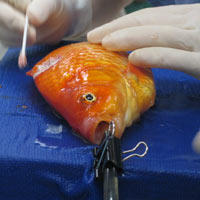
As I mentioned a while ago, I just finished a mini-documentary on the world of fish medicine for PBS's Nova ScienceNOW series. I also did an in-depth photo and audio slide show for the ScienceNOW website, which explores the most common pet-fish ailments, and the ways fish owners diagnose and treat them (MRIs, CT scans, fish surgery, chemotherapy, you name it -- all for pet fish). This piece is a follow up to Fixing Nemo, a story I did about fish surgery and fish medicine for the New York Times Magazine

The audio show is now live, so take a look. [Update: The entire show is now available online. You can visit the Nova ScienceNOW website to watch the show online, listen to the audio slideshow, and read an extensive Q & A with Dr. Greg Lewbart on fish medicine.]

The full show, which airs on Tuesday October 18th at 8pm (EST) on PBS, is a follow up on my New York Times Magazine article, Fixing Nemo, which ran last year. It covers current developments in the field, and it's filled with incredible footage of goldfish laser surgery, fish owners explaining the intense bonds they develop with their fish, and more. So mark your calendars, and tune in!

Labels: , , , ,

Friday, September 02, 2005

On The Road Again & Fish Medicine

As you may have figured out from my air silence the last couple weeks, I'm on the road again. This time I'm in Pittsburgh, where I'm teaching at the University of Pittsburgh as a visiting writer for the fall semester (in the Cathedral of Learning, pictured left).

I got to Pittsburgh a few days ago after an exhilerating week in Baltimore teaching at the Mid-Atlantic Creative Nonfiction Summer Writers Conference -- an intensive event filled with readings, panel discussions and heavy workshopping. I teach there every August, and it's always one of the best parts of my summer ... like geek summer camp for writers, only better. It's endless fun.

From Baltimore, I headed straight for a crazy-fun week in North Carolina with Dr. Greg Lewbart, where I filmed a segment for Nova ScienceNOW about fish surgery. That's right: Fish medicine. There's a whole field of veterinary medicine devoted to treating fish. We're talking MRIs, CT scans, bloodwork, surgery, pain medications, you name it -- procedures that cost hundreds, sometimes thousands of dollars, to treat pet fish. Everything from fancy koi to regular goldfish people win at fairs. I wrote about this last year in a New York Times Magazine called Fixing Nemo, but the Nova segment will cover fresh ground: It explores new developments in the field, and really getting into the isue of fish personality, and the relationships people form with their fish. It does all of this with beautiful television footage, which means that when it airs (October 18th on PBS) you can see this stuff with your own eyes -- you can watch a fish surgery performed by one of the nation's top fish vets (known in the field as "The Big Fish"), and you get to meet several personality-filled fish, and the people who love them. I'll post a reminder about it when the time is closer.

Labels: , , , ,

Tuesday, June 21, 2005

On Writing: Flabby Coverage

The second (and sadly final) installment of my Popular Science column "Mediascope" just hit the press (in the July 2005 issue). This time, I go into the truly embarrassing way the media covered the recent CDC obesity studies. Unfortunately, as the July issue hit the news stand, Popular Science decided to nix the entire column section of the magazine (with columns by me and two other writers), to make room for new features they wouldn't have space for otherwise. And just when I was starting to have fun with it ...

But the good news is, I've been talking to an editor at a different (yet-to-be-named) magazine, who will hopefully pick up where Popular Science left off. So for all you folks out there who've been emailing me saying how much you appreciate the column, stay tuned: I'll post an update as soon as I know where it will be published from here on.

As for the book: The deadline clock is ticking (very loud -- if I could find a way to turn it down, I would. It has a tendency to wake me up at night). But all is going very well. I have written more in the last few months than I thought was humanly possible. Who knew a person's arms and legs could get so sore from just sitting in one place without moving for so (SO) long ... at least I have a beautiful view (and air conditioning).

So, without further delay, here's my latest column. Obesity is a very sensitive and complicated issue -- especially in this country -- so this column is one I imagine I'll hear from a lot of readers about. (I've already gotten responses asking all kinds of questions; I'll post my replies here as soon as I'm able to write them.) Until then, here's the column:

A few weeks ago, I was eating in a restaurant in West Virginia (the second fattest state in the country), staring blankly at a television and thinking, I really should join a gym; this sitting-on-my-butt-all-day-occupation is showing. Suddenly the newscaster said, "Before you start that next diet, you won't want to miss this one! A new study suggests that those few extra pounds may actually help you live longer." To say there was a collective sigh of relief in the restaurant -- in the entire country -- would be an understatement. I found myself surrounded by strangers gaping at each other as if the newscaster had just announced the end of a military occupation: Did you hear that? We're free! They joked about ordering more pie, and I half expected them to start toasting each other with French fries.

The headlines read like a dream: "Gov't Overstated Danger of Obesity," "Fat May Be Good." Two New York Times columnists said that the fight against obesity had "lost the scientific high ground." They taunted "people who work out, eat responsibly," those "salad-munching health nuts" who, they gloated, would die young because, according to a Centers for Disease Control and Prevention study, overweight people actually live longer than normal-weight people."

But wait: Only a month earlier, the Washington Post had reported a high-profile University of Illinois study showing that skyrocketing obesity rates are shortening life spans "[more] than the impact of car accidents, homicides and suicides combined." And major news outlets said studies revealed that "obesity triples the risk of dementia" and causes breathing problems. So what's the deal?

... click here for the rest of the column.

Labels: , , ,

Thursday, June 02, 2005

On Writing: Mediascope

Today (actually, yesterday) marks the first day of my new column for Popular Science magazine. It's called Mediascope, and my goal with it is to let readers know when big science stories are a lot of hype, and to get into the real science behind the headlines (as much as I can in less than 1000 words). My first column, Hype That Breaks Your Heart, digs into the recent media blitz over so-called "Broken Heart Syndrome," but it also tells a bit about why I decided to write this column in the first place:

"When mosquitoes brought West Nile virus to New York, all the papers said it was going to be the next big deadly epidemic (which, of course, it wasn’t). The day the news came out, I was in my garden in Pittsburgh, and a mosquito landed on my arm. I smacked it, then immediately thought, “Oh my god! West Nile virus!” So I ran inside and did something I hadn’t done since grade-school summer camp: I doused myself with insect repellant. Then I got a whiff of the fumes and remembered I just read an article saying insecticides cause Parkinson’s disease!
I’m only slightly ashamed to say I screamed, ran like a girl, and jumped in the shower. Then I came to my senses. I was a trained scientist who knew better than to fall for every this-is-going-to-kill-you headline; if those articles flipped me out, what were they doing to the general public?

"I decided to write an article about the science behind health-media freak-outs. Every epidemiologist I talked to—even those whose research depended on West Nile being a threat—said the coverage was hype. The same was true for most of the stories I investigated: The Impending Mad Cow Disease Epidemic, Hanta Virus Wiping Out the West, The Return of Bubonic Plague—none were completely true to the science. And nothing has changed."


When I turned this column in to my editor, he called me back and said, Come on, don't exaggerage, you didn't really get in the shower after that bug spray thing, did you? I did, I told him, which will come as NO surprise to those of you who know me. I admit it, I'm a bit of a hypochondriac, and honestly, this column should probably be called something like "Hypochondriac's Journal" instead of Mediascope, because more than anything, it's a way for me to investigate the truth behind scary-sounding stories, to decide whether I (and my readers) sould be freaked out by them. Fortunately, the answer so far is no:

You can read the first column about Broken Heart Syndrome here: "Just in time for Valentine’s Day, the news hit that a breakup or a surprise party could kill us. Well, not quite."

And tune in next for next month's column (which will hit news stands in a couple weeks) for my take on the recent embarrasment that was the media coverage of the most recent CDC study on obesity.

Labels: , , ,