Monday, April 30, 2007

Messiness Linked to Creativity

Hallelujah ... that's all I can say about this. Hall-e-freakin-lujah:

From Prevention Magazine: "People who inhabit moderately messy spaces are more creative than those who work in very organized ones, says Columbia University management professor Eric Abrahamson, coauthor of A Perfect Mess: The Hidden Benefits of Disorder. Amid clutter, many famous thinkers have made serendipitous connections between seemingly unrelated documents that led to great success."

I would post a photo of the way my office looks this very second to illustrate why I find this news so exciting. But I can't find my camera.

Labels: , , ,

Sunday, January 07, 2007

Cuteoverload

Yes, it's true ... I, like thousands of other sensible people out there, am completely addicted to Cuteoverload. And I'm not ashamed to admit it.

But it's not like I haven't gone very public with animal obsession several times already ... sometimes quite aggressively.

Labels: , , ,

Saturday, December 30, 2006

How to Teach Kids About Puberty

This is fabulous: a video from the NEMO Science Center's "Teen Facts" exhibit ... it is, as the website says, an "animated educative film showing a scientific experiment. For three minutes two kids are exposed to ten years of puberty." The narrator is a riot. The thing I find most interesting, culturally speaking, is that this video openly embraces the sexuality of teenagers. Naturally, it's from the Netherlands, not America, where many teaching teens about puberty like to pretend the sex portion of the lesson is optional. (Thanks once again, Marc)

Labels: , ,

Thursday, May 25, 2006

Cuteness, Funny Mugshots, and Print-on-Demand Marriage Proposal Books

Okay, since I've been spending a lot of time sitting by the hospital bed of a good friend, I'm big on things that make me laugh right now (actually, I'm always big on things that make me laugh). And I'll tell you, goofy as it may sound, Cuteoverload gets lots of points. Just look at this picture, or this one (!!), or this one (I could go on and on, but I'll stop now).

So, in keeping with my current quest for humor, I have to post these two things: First, The Smoking Gun has this hilarious feature on people who do it up for their mugshots -- some of them are great. I mean, really, if you're busted, you're busted. May as well make the best of it, right?

Then there's this, which I posted on Critical Mass today, but wanted to include here too: A man has proposed to his girlfriend by creating and giving her a 105-page print-on-demand book called, "50 Reasons Why You Should Marry Me and 51 Reasons Why I should Marry You," by Cameron Kelly. The book is available for sale through Lulu, where you can read the entire thing as a sample PDF (thought I would think you were very strange if you did that -- skimming it for voyeurism's sake is one thing, but reading it all is completely different).

A press release announcing the sale of the book listed some of the reasons she should say yes, including: "Because I clean the bathroom every week. Because I cut my hair. Because I love the way you say 'crayons.'" And, as the book-description notes, there are "FULL COLOR photographs throughout."

At this point, the book has a 4 star customer rating (out of a possible 6 stars), but its target audience seemed pleased: She said yes. How could you not? Come on: The guy's a riot. And making that book took serious balls. (Thanks Clive!)

Labels: , ,

Saturday, February 11, 2006

On Science: The Faulty Logic of Religious Meningitis

According to a new study, teenagers who French kiss multiple partners nearly quadruple their risk of getting meningitis. Fine. This makes scientific sense: You can get meningitis by kissing people, you kiss more people, you increase you risk of getting it. But they also found that attending religious ceremonies decreases the risk of getting meningitis. Come now: Religious ceremonies don't protect them. What protects them is (a) meningitis vaccines and (b) kissing fewer (or healthier) people. Saying church has anything to do with it reads like a perfectly incorrect answer on an SAT test: Bacterium is to Brain Infection as Atheism is to ... Meningitis?? I don't think so.

Labels: , , ,

Tuesday, January 24, 2006

Of Note: Fish Tricks

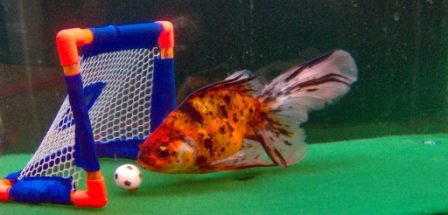
Today's Pittsburgh Post Gazette ran a story about a local man and his son who've trained their goldfish to do the limbo, play football and shoot a soccer ball into a net. The fish's owner, Dean Pomerleau, has written an e-book (called "Fish School Manual"), which he's selling through his website for the low price of $5.95, which means that you too can teach your fish to do tricks ("Money Back Guarantee"). His website is a must-see: It's got videos of fish playing soccer, dancing, you name it.

The website says, in big bold letters, "This is NOT a joke." That's right. Truth is, teaching fish to do tricks is nothing new. People have been training their goldfish for years: The first book on the subject was published in 1995, but people have been doing it far longer than that. When I was working on my story about fish medicine (and interviewing people who spend thousands of dollars taking their pet fish to the doctor), I met several people who'd taught their fish to dance, swim through hoops, swim little flips on command. As one of my favorite fish vets always says, "Fish are a lot smarter than we give them credit for."

Labels: , , ,

Sunday, December 11, 2005

On Writing: Contagious Yawning (and celebrity Teeth and Unpopped Popcorn)

Today the New York Times Magazine published three short stories of mine as part of their annual Year in Ideas issue -- a catalogue of interesting ideas from 2005. This issue is always a blast to write for: Last year I got to write about Eyeball Jewelry and one man's quest to Make The National Anthem Singable. This year it's Why Certain Popcorn Kernels Won't Pop, and People Who Want celebrities' Teeth and Why Yawning is Contagious.

The yawning story, which was probably the most interesting one, had to be short for space reasons, so there was a lot I couldn't go into: The scientist I wrote about, Steve Platek, is actually interested in using contagious yawning to study the evolution of human consciousness, which is completely fascinating and at points mind-boggling abstract.

Platek, as the story explains, has found that contagious yawning has to do with empathy: The more empathetic you are, the more likely you are to relate to a yawner and experience a yawn yourself. The way this relates to consciousness is almost counter intuitive: The neural pathways involved in empathy are the same pathways involved in self-awareness, because we empathize with people by tapping into our own experiences. Self-awareness gives us a reference point for empathizing with people: You fall down on the sidewalk and get embarrassed, and I feel embarrassed for you because my brain remembers a time when I felt the same.

Yawning exists in all living creatures: Insects, fish, birds, reptiles, mammals, you name it. But contagious yawning only exists (as far as scientists know) in humans and certain "higher primates" that have been shown to have "empathetic abilities." (Don't get me started on this idea that some animals are self-aware and others aren't -- I have issues with that, but I won't go into it here.) The way Platek sees it, at some point in evolution, certain brains -- specifically those of humans and some primates -- evolved a level of consciousness that allowed them to experience empathy (and therefore contagious yawns), and other brains didn't.

"In trying to understand something like the evolution of the self, of consciousness and empathy," Platek told me, "we need specific tests for it. We can't use Petri dishes and microscopes to see these things, so we have to develop creative ways of looking for evidence that they exist." Which is precisely what contagious yawning is, Platek says. It's a cue that a brain has a level of self-consciousness that makes "empathetic mechanisms" possible.

Platek and I had a great time talking about yawning. When we got to this point in the conversation I said, Wait a minute ... You're saying you can study consciousness by looking at yawning? To which he said, Yep, that's right: "Contagious yawning is a way for science to have a window into understanding the basic neural mechanism that may have given rise to the evolution of consciousness, or what we call the human condition." Then he paused.

"Whoa," I said, "that's heavy."

"I know," he whispered, laughing. "I was just thinking the same thing: It's weird. We were talking about yawning and now I'm talking about consciousness!? But that's where it all came from, so that's what happens. You talk about yawning, you end up at consciousness. "

Who knew studying yawning could be so useful. And there's more: Certain types of brain damage can cause people to suddenly lose their empathethic abilities, so contagious yawning can serve as a test to see if your brain is functioning normally. Yawning is also a very curious (and little understood) side effect of certain drugs -- especially impotence drugs, which has led one researcher to investigate the connection between sexuality and yawning. Then there's scizophrenia (as I mentioned in my last post): Platek uses people with schizophrenicenic tendencies to study contagious yawning -- since schizophreniaenia interferes with empathetic abilities, it can make people immune to contagious yawns.

Clearly, I could go on and on about yawning. And I will with a longer story soon. But until then, I'll end with this: You want evidence that yawning is contagious? Just do a google images search for "yawn" and start looking through the pictures ...

Labels: , , , ,

Wednesday, October 12, 2005

Fish Medicine Audio Slide Show Now Live

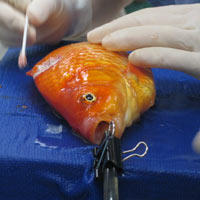
As I mentioned a while ago, I just finished a mini-documentary on the world of fish medicine for PBS's Nova ScienceNOW series. I also did an in-depth photo and audio slide show for the ScienceNOW website, which explores the most common pet-fish ailments, and the ways fish owners diagnose and treat them (MRIs, CT scans, fish surgery, chemotherapy, you name it -- all for pet fish). This piece is a follow up to Fixing Nemo, a story I did about fish surgery and fish medicine for the New York Times Magazine

The audio show is now live, so take a look. [Update: The entire show is now available online. You can visit the Nova ScienceNOW website to watch the show online, listen to the audio slideshow, and read an extensive Q & A with Dr. Greg Lewbart on fish medicine.]

The full show, which airs on Tuesday October 18th at 8pm (EST) on PBS, is a follow up on my New York Times Magazine article, Fixing Nemo, which ran last year. It covers current developments in the field, and it's filled with incredible footage of goldfish laser surgery, fish owners explaining the intense bonds they develop with their fish, and more. So mark your calendars, and tune in!

Labels: , , , ,

Wednesday, October 05, 2005

Of Note: Python Explodes After Eating Alligator

Really, the headline on this one says it all. Rangers just reported that a 13-foot python ate a 6-foot alligator, and the result wasn't pretty. The snake tried to swallow the gater whole -- then the snake exploded.

Apparently, clashes between pythons and alligators are becoming increasingly common in the Everglades, where people have developed the annoying habit of dumping their pet pythons when they get too big to keep around the house (say, six feet long, or more). This has the makings of a tremendous problem: They're encroaching on an $8 billion dollar Everglades restoration project by eating the native otters, the endangered birds ... and now the alligators? Encounters like this simply aren't natural -- these snakes are a native species of Asia. They're not supposed to be fighting Florida alligators. But this is the fourth battle of its kind.

Frank Mazzotti, a University of Florida wildlife professor, is quoted by VZW News (which isn't online or I'd link to it) saying that in this case, the alligator and python "were probably evenly matched in size ... if the python got a good grip on the alligator before the alligator got a good grip on him, he could win." But, he says, after being swallowed whole, the alligator apparently clawed at the pythons stomach from the inside, causing the snake to explode. The remains found by the rangers were a mess: The alligator's hind end protruding from the snake's midsection; the snake's stomach still wrapped around the alligator's head, shoulders and front legs ...

This is an unfortunate blow for the folks in the Everglades restoration project -- they've been hoping the alligators might control the rapidly growing Burmese python population. "This indicates to me it's going to be an even draw," Mazzotti said. "Sometimes alligators are going to win and sometimes the pythons will win." Then, in one of the most striking understatements of the day, the BBC quotes Mazzotti saying "Clearly, if they can kill an alligator they can kill other species ... it means nothing in the Everglades is safe from pythons ..."

See, now that's just one more reason I live in New York City: No pythons, no alligators, and no quicksand ...

Labels: , ,

Thursday, September 29, 2005

Of Note: Scientists Finally Quell My Quicksand Phobia

It's fair to say that, growing up, I worried more than your average kid. I worried about normal things, like my parents dying. But more than anything, I worried about the impossible: Airplanes falling from the sky and landing on me; my brother getting drafted and shipped off to die in battle at age ten. At one point, thanks to Tarzan, I became acutely phobic of killer bees and man-eating-ants. My parents told me they didn't exist in the US, but I looked at a map and convinced myself that they could easily come from South America to my backyard in Illinois. But my biggest phobia for several years -- one that kept me up at night -- was quicksand.

My brother and I watched a lot of weird 70s jungle shows -- and played weird jungle video games -- so in my world, people were constantly getting stuck in quicksand. They'd flail around screaming as friends threw them sticks, shirts, whatever -- desperately trying to pull them out -- but nothing ever worked. And it all happened so fast: They were just walking along and suddenly, squish, they're up to their waist, chest, neck, then they're gone. Just like that.

I secretly feared walking in the park down the street from my house because of the quicksand. Today, I know there was no quicksand in Illinois. But as a kid, it seemed an obvious risk: There were vines hanging from trees, there was sand on the trail, it looked just like the woods in the movies -- why wouldn't there be quicksand?

I'd completely forgotten about this old phobia of mine until a few months ago, when I watched Lawrence of Arabia for the first time in years. At what felt like hour six in the movie, there's a graphic scene where a young boy dies in quicksand. At that point, I suddenly remembered my old quicksand fear and thought, See, that's why I live in New York City ... no quicksand!

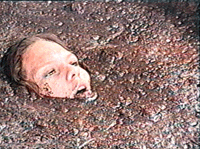
So all of this is to say, I was very relieved to hear the news yesterday that scientists have reported that quicksand is not, in fact, as dangerous as all the movies make it seem. If you fall into quicksand, instead of being completely consumed by it, you will actually only sink to your waist. Then you float. But you're not exactly homefree: To just pull one leg out of quicksand, their study says, it takes the same amount of force needed to lift a car. Fortunately for all of us, the scientists offer tips for getting out:

"... while the risk of vanishing has apparently evaporated, escaping the muck is still a tough task: ... There are tricks, however. Quicksand is a mixture of fine sand, clay and saltwater. Once perturbed, the mixture transforms from a loose packing of sand on top of water into a dense, liquid soup. Movement by a victim makes things worse.

"The higher the stress, the more liquid the quicksand becomes, so movement by a trapped body causes it to sink in deeply," study leader Daniel Bonn of the University of Amsterdam writes in the Sept. 29 issue of the journal Nature. After the mix liquefies, the quicksand splits into a water-rich phase and a sand-rich one. The wet sand sediment becomes so densely packed that it's harder to move than cold molasses. Once the victim's foot becomes stuck in it, the situation is dire ... How to get outBonn and his colleagues found, however, that if a you remain calm, you can actually float your way to safety.

"The researchers simulated a quicksand pit in the lab and placed an aluminum ball of greater density than the quicksand on top of the pit. The ball didn't sink until the researchers began to shake the pit, simulating movement and turning the mixture of sand and water more liquid. When they did this, the ball sank right to the bottom.

But when they used an aluminum ball with a density equal to the human body, which is less than the density of quicksand, they found it impossible to sink the ball, no matter how hard they shook the pit ... The advice : Stay calm and eventually you'll float. Stretch out on your back to increase your surface area and wait until your legs pop free. Bonn also suggests moving your legs around at this point, to stir in water, which will help you float. "You have to introduce water into the sand," Bonn said. "And the easiest way to do that is to make it trickle along your leg into the quicksand, by making a circular motion with your leg."
Now, call me crazy, but I'm thinking -- if I'm stuck in quicksand and the only thing that can get me out is some water trickling down my leg, I'd be making more than circular motions, if you know what I mean. But either way, I'm in no hurry to test their theory: They did this reserach using aluminum balls in simulated quicksand. I'll wait until they work it out with actual people in actual quicksand ...

Labels: , , , ,

Thursday, July 14, 2005

Of Note: How Science Finally Vindicated My Hate of Showering

When I was a kid, I refused to shower. Not just once, but always. My parents spent much of my childhood trying to think up new and clever ways to trick me into showering (buying cool shampoos and body-paint soap, or calling the whole thing "shaking a tower" instead of "taking a shower"). But nothing worked. I'd lock myself in the bathroom, turn on the water, stick my hair under the faucet so it looked showered, give my dry body a quick rub with a bar of soap so it smelled showered, then sit on the toilet lid with the water running for a while to make the whole thing seem legit. Of course, I did end up in the shower fairly regularly, but it was always a fiasco of tears and whining and flailing arms and legs.

The thing is, honestly, I never got over hating showers. I mean, don't get me wrong ... I shower, and no one has to throw me in the tub. I just don't like it. Feels like a waste of time: The shaving, the hair washing and hair drying, it takes forever. So getting me into the shower is still a chore: I'll walk around the apartment all day saying "I'm about to get in the shower" while my boyfriend laughs at me saying, "yeah, right."

Needless to say, this is not something I usually discuss publicly. But ALL of this is necessary background to understand why I feel especially vindicated by the recent news that daily showers can actually cause brain damage.

Scientists believe that breathing in small amounts of manganese found in water may harm the central nervous system. Dr John Spangler, of Wake Forest University in New Carolina, said: "If our results are confirmed, they could have profound implications for the world. Inhaling manganese, rather than eating or drinking it, is far more efficient at delivering it to the brain." Manganese is in food and rocks and enters the air, soil and water. It damages the brain leading to learning difficulties, tremors and changes in behaviour. Dr Spangler's team claim that a 10-minute shower a day for 10 years would expose children to three times higher doses than would be needed to damage a rat's brain. Adults with more years in the shower would receive doses 50 per cent higher.

See! I knew there was a reason I hated showers! I read this and immediately emailed my best childhood friend, Quail, who also happens to hate of showers. I sent her the article and we emailed back and forth all day feeling brilliant about the whole thing: "All those people who made fun of us for hating showers are going to get manganese brain poisoning!"

It's actually not big news ... it's kinda just common sense: if there are things in the water, those same things are probably present in the water vapor, and you probably breathe them in when you shower. Just after high school, I worked in a natural pet food store in Oregon (yes, it's true) with a quirky high-strung woman named Nancy who was in her 70s but looked 40. She always swore that the secret to her youthful longevity was that she never took hot showers, because she didn't want to breathe in any vaporized chemicals from the water. Last time I talked to Nancy she was in her 80s and still hyper as ever. Maybe she was on to something.

Labels: , , , , ,

Tuesday, April 12, 2005

Of Note: Robotic Camel Jockeys

After being accused of human rights violations for using children as camel jockeys, Gulf Arab officials have unveiled the robotic camel jockey in an attempt to "bring order to the national sport" of camel racing:

The US State Department and human rights groups have raised the alarm over the exploitation of children by traffickers who pay impoverished parents a paltry sum or simply resort to kidnapping their victims.

The children, mostly from Bangladesh, Sri Lanka or Pakistan, are then smuggled into the oil-rich Gulf states. They are often starved by employers to keep them light and maximize their racing potential. Mounting camels three times their height, the children - some as young as six - face the risk of being thrown off or trampled ... [a] Swiss company was paid around $1.37 million to produce the robots, which will cost just under $5,500 apiece ... Qatar's main camel race carries a prize of more than 190,000 dollars, 10 percent of which goes to the parent or guardian of the jockey, who also gets a monthly salary of up to 400 dollars.

Labels: , ,