Culture Dish Move Complete - New Feed Now Live
Labels: Housekeeping
Rebecca Skloot's blog on Science, Writing, and Life.
Labels: Housekeeping
Update: The Culture Dish move is now complete, and the new Culture Dish feed is now live. Please update your subscription and we'll see you over on the new site!Labels: Animals, Housekeeping, My Publication News
That's right, today is moving day. Please update your links or RSS feeds or whatever it is that you use, and come check out Culture Dish at its new home on ScienceBlogs, complete with an inaugural post. I'll be keeping my archives here for a while until I figure out how to move them over to the new server, but eventually I'll transfer them and close down this site entirely.Labels: Housekeeping
Yes, it's true: Culture Dish is still alive under all the dust and cobwebs that have accumulated since my last post. The good news: My book, The Immortal Life of Henrietta Lacks, is finished and headed toward publication (which is why Culture Dish went on hiatus), and I'll be back to blogging soon. I'll also be launching a new website at rebeccaskloot.com as well as giving Culture Dish a serious makeover. First step: It's moving to ScienceBlogs. Stay tuned for more information, including a link to the new blog location once it's up and running ...Labels: HeLa, Henrietta Lacks, Housekeeping, My Book, Personal Updates
As anyone who's visited this blog in the last many months has noticed: Culture Dish has been sleeping. Teaching, freelancing, column writing, book work, travel and blogging over at Critical Mass have left little time for personal blogging lately. But I'll be starting up a pets blog for Prevention Magazine soon -- a companion blog for my monthly column there -- so stay tuned for more information about that. And once my book hits stores, I'll be back blogging on my own as well.Labels: Personal Updates
Some time ago, I wrote this story for the New York Times Magazine titled, "Taking the Least of You: Those blood and tissue samples you routinely give - where are they? Who owns them? What are they being used for? And how come you don't know?" Since that story ran, I've been publishing updates here on the Washington University vs. William Catalona trial that I covered -- it was a potentially landmark court case that questioned whether patients can control the use of their tissues in research, and whether they retain any property rights in their excised body parts (in this case, Washington University claimed ownership of 6,000 tissue samples from patients who asked that their samples be removed from the university's prostate cancer bank, which is worth millions of dollars).Labels: Bioethics: Use of Human Tissues, Publication Updates, Research Ethics, Science and Money, Science: General
My latest pets column, The Good Good-Bye, has just hit the stands in the July issue of Prevention Magazine. As you'll see, it's about something near and dear: Dealing with the loss of a pet both emotionally, and logistically.Labels: Animals, My Publication News, Publication Updates
For those wondering why my blog has been so quiet lately, here's why: I've accepted a faculty position at The University of Memphis, where I'm moving in exactly two weeks (which explains why I've had this great song stuck in my head for months). I'm really excited about the move (the food! the music! the Reverend Al Green! Elvis! the mississippi delta! huge fenced-in backyard for the dogs! kool-aid pickles!?), and about working with such great writers in the MFA program there, where I'll teach creative nonfiction. The plan at this point: Live in Memphis during the academic year, and spend the rest of the year back in NYC and in my native Portland, Oregon. Labels: Personal Updates
I'm happy to report that I am now writing a monthly column about Pets for Prevention magazine. An editor at the magazine contacted me after reading this article I wrote about my dog Bonny plus several animal-related posts on this blog -- she suggested I combine my love of animal stories with my decade of experience as a veterinary technician to write a regular series for Prevention (which I thought was a fabulous idea).Labels: Animals, My Publication News, Prevention Pet Column, Writing
Hallelujah ... that's all I can say about this. Hall-e-freakin-lujah:Labels: Just Plain Silly, Latest Discoveries, Neuro, Weird Science
New studies show, yet again, that technology makes us stupid. Or at least less effective. And that the best way to accomplish something successfully -- whether it's driving a car, crossing a street, standing in a train station, or writing a book -- is to turn off the tech. I've blogged about the problems that come with constant emailing several times in the past. Now, today's New York Times reports on the newest studies into how multitasking messes with your brain:"The human brain, with its hundred billion neurons and hundreds of trillions of synaptic connections, is a cognitive powerhouse in many ways. “But a core limitation is an inability to concentrate on two things at once,” said René Marois, a neuroscientist and director of the Human Information Processing Laboratory at Vanderbilt University.
"Mr. Marois and three other Vanderbilt researchers reported in an article last December in the journal Neuron that they used magnetic resonance imaging to pinpoint the bottleneck in the brain and to measure how much efficiency is lost when trying to handle two tasks at once. Study participants were given two tasks and were asked to respond to sounds and images. The first was to press the correct key on a computer keyboard after hearing one of eight sounds. The other task was to speak the correct vowel after seeing one of eight images."
"These experts have some basic advice. Check e-mail messages once an hour, at most. Listening to soothing background music while studying may improve concentration. But other distractions — most songs with lyrics, instant messaging, television shows — hamper performance. Driving while talking on a cellphone, even with a hands-free headset, is a bad idea."
Labels: Latest Discoveries, Neuro, Science News, Technonlogy, Writing
Here's a newsflash I never thought I'd hear: Yesterday, with Frances Collins by his side, Bush began lobbying for Congress to pass the long-stalled Genetic Privacy Bill, which could help protect patients from genetic discrimination. This bill, in one form or another, has been in the works for about a decade, but has repeatedly been pushed aside over fears that it might inhibit research and industry. I'm very interested to see the version of the bill they're working with now, how it's changed since its last incarnation, and whether/how it will protect patients against insurance and other discrimination. If it does, passing it would be a huge step forward for the world of tissue research, one patients rights advocates have been fighting for endlessly.Labels: Bioethics: Use of Human Tissues, Genetic Testing, My Book, Research Ethics, Science and Money, Science News
Police in India have found still more evidence of a black market in human organs: kidneys being sold illegally by fishermen and their families whose villages, boats, and incomes were destroyed by the 2004 tsunami. The AP reports on what one police officer describes as "a big racket":Labels: Bioethics: Use of Human Tissues, My Book, Science and Money, Science and Risk
In my ongoing coverage of all things human tissue related, I came across this article about a recent study examining public attitudes toward tissue banks: "Tissue banking raises cloning fears." Interestingly, there was absolutely no coverage of this study in the U.S., where tissue research is a huge issue. The study, conducted by the Centre for Values, Ethics and the Law in Medicine at the University of Sydney, shows that Australians have many concerns over how their tissues are being used.Labels: Bioethics: Use of Human Tissues, My Book, Publication Updates, Research Ethics, Science and Money, Science News
Labels: Animals, Science News
Yes, it's true ... I, like thousands of other sensible people out there, am completely addicted to Cuteoverload. And I'm not ashamed to admit it.Labels: Animals, Just Plain Silly, My Publication News, Publication Updates
This month's O, Oprah Magazine just hit the stands with my article, "Why is it So Damn Hard to Change," which looks at the neurology behind why it's so friggin hard to break old habits and pick up new ones (just in time for all those New Year's Resolutions). The story explores the workings of the human brain when it comes to exercising and dieting, quitting smoking, drinking, drugs, gambling ... you name it. I had a great time with it. Labels: My Publication News, Neuro, Publication Updates
Labels: Just Plain Silly, Sex Ed, Weird Science
In a wonderful study titled, "Comparative Sex-Specific Body Mass Index in the Marvel Universe and the 'Real' World," a group of scientists has calculated the Body Mass Index (BMI) of Marvel comic strip characters and compared them to actual people, to see how comics stood up.Labels: Weird Science
Today's New York Times Magazine published four stories of mine as part of their annual Year in Ideas issue -- a catalogue of interesting ideas from 2006. The stories are short, but oh so much fun:Labels: My Publication News

I posted about this earlier today on Critical Mass, but had to post it here too, because it's a subject near to my heart: Discover Magazine has just published their list of the 25 Greatest Science Books of All Time. They picked Darwin's Voyage of the Beagle and Origin of Species as number one. If you disagree with them, go vote on a different one ... you can choose one from their list, or add one you think they missed. (I can't believe Lewis Thomas didn't make the top 25!)Labels: Books, Science Writing
Here's some breaking news in the it's-about-time department: China has finally agreed to create organ transplant rules that will, as the AP says, "prevent unqualified doctors and profit-hungry hospitals from abusing patients." This comes in the wake of reports finally documenting what's been clear anecdotally for years: It's common practice in China to harvest organs from executed prisoners, often without consent.I just want to know, what took so long?
(AP) "The draft regulation, which has been sent to the State Council for review, would require a new organization under the Ministry of Health to be in charge of registering and allocating all donated organs, the official Xinhua News Agency said. It said the regulations were expected to be passed soon, but gave no specific timetable.
Little information about China's transplant business is publicly available, and critics contend it is profit-driven with little regard for medical ethics. China has long defended the practice as legal ... Xinhua said that China's lack of clear organ transplant laws had led to transplants being carried out by "unqualified doctors with substandard medical equipment" which had caused deaths among patients. It also said there was a popular perception that Chinese hospitals were sacrificing quality care in order to perform many costly transplants." Full story here.
Labels: Bioethics: Use of Human Tissues
Okay, this is absolutely awful: South Korea has just announced that they're going to begin slaughtering about 600 dogs and "an unspecified number of cats" because of fears over bird flu. There's a big outbreak of it there in chickens, so the South Korean government has been slaughtering those the thousands to prevent the virus's spread, which is what they're supposed to do, according to the WHO. Fine. But now they're going to slaughter all the dogs and cats in the area?! This is insane. There has never been a single case of dogs or cats catching bird flu and passing it on to humans. There is, in fact, no scientific evidence that such a thing is possible. Several Asian countries have been criticized for not taking the risk of avian flu seriously, so it's good South Korea isn't doing that ... but this is ridiculous.Labels: Animals, Botched Science
For those who were properly impressed by the singing basenji I posted about last week, I give you Gibson (pictured left) the world's tallest dog (honest), who happens to be able to say "I love you." Really, check out his site and click on the paw under his picture. If you're like me, you'll click it compulsively about 20 times to hear it over and over again ... (thanks for that tip, Sarah!)
The other thing you'll do if you're like me: After verifying that Gibson is indeed the world's tallest dog, you'll waste far too much time looking at lots of other amazing things ... the world's longest rabbit ears, for example, or my personal favorites: Most tennis balls held in the mouth (pictured right) and fastest car window opened by a dog. Good stuff.Labels: Animals
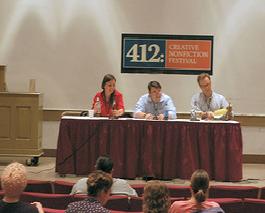
I just got back from several weeks of writing stories in hotel rooms and speaking at the 412 festival in Pittsburgh (pictured left, with Michael Rosenwald and Daniel Nester, talking about freelancing) and the Nieman Narrative Nonfiction conference in Boston, where I spoke about freelancing, writer/editor relationships, and narrative science journalism (including a panel with the wonderful Michael Pollan). The highlight of Nieman for me: hanging with Joe Sacco and Stacy Sullivan and finally getting to meet Marc Abrahams (I must hear the end of that story, Marc!)Labels: Animals, Bioethics: Use of Human Tissues, Bioethics: General, Personal Updates, Science and Money
The Kenyon Review blog has an great two part interview with Michael Lemonick, a senior science writer for Time magazine and author of several science books. They talk with him about everything from his background and writing style to developing story ideas, making science sexy, and more. Check it out: Part I and Part II. Lots of good stuff there.Labels: Science Writing
This could get interesting: A tiny biotech company called Enzo Biochem has just stepped forward claiming that they invented the technique for sequencing DNA, though the patent on it was awarded to some scientists at Caltech nearly 25 years ago. According to today's New York Times: "the government says it will consider, nearly a quarter-century after the invention was made, whether it awarded the patent to the wrong party." It will be fascinating to see how this turns out, and what they'll do if the patent is reversed and granted to Enzo, how they'll deal with the massive amounts of money Caltech and Applied Biosystems -- the company that licenses the patent from them -- have made from it. And we're talking about a lot of money: This is the technique used to sequence the human genome.Labels: Science and Money
I absolutely love this: Basenjis are always billed as barkless dogs, which most people take to mean they're quiet dogs. Not so. They, like malamutes, can't bark, but they can do all kinds of other things with their voices and often do. Much to the surprise of many new basenji and malamute owners, they're two of the most vocal breeds out there. Having had a malamute for 16 years, there's nothing I love more than the sound of a non-barking dog making noise ... it's melodic, nearly verbal, and totally hilarious. So I was very pleased to see that someone has recorded this wonderful duet for Basenji and flute. I laugh very hard and very loud every time I listen to it. Thanks to Marc over at Improbable Research for posting it.Labels: Animals
Given my ongoing obsession with human tissues, here's a new development I can't help posting about: Through a company in the UK, it's now possible to get "biojewellery" -- a personalized wedding band made from the cultured bone cells of your future spouse.Donors have their wisdom teeth removed in an hour-long surgery so bone cells can be extracted from their jawbones (!). And people are lining up to do it: The company recently selected four couples out of hundreds of applicants wanting to be part of an upcoming art exhibit, which will display couples' bone rings, their stories and photos.
Labels: Bioethics: Use of Human Tissues, Science and Money, Weird Science
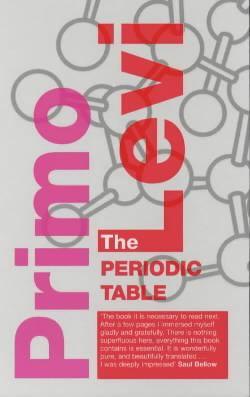
The Imperial College London has taken the very bold move of naming Primo Levi's "The Periodic Table" as the best science book ever, right up there with surprising front-runners like Norman Mailer's "A Fire on the Moon," and Jonathan Lethem's "As She Climbed Across the Table." I can't imagine picking one science book as best ever -- even if it was written by Levi -- but I absolutely love these folks for branching out from the predictable by focusing on narrative and including fiction in the running. This world needs more books that combine good narrative and science. Make sure to read through the science books blog by Jon Turney -- the professor behind the project -- is a wonderful resource for finding unexpected or forgotten science books.Labels: Books, Science Writing
Here's some crazy brain research for you: Most people, at some point or another, have had that creepy feeling that somebody's nearby. That they're being watched. Well, a group of scientists just figured out that they can stimulate that disturbing feeling by applying electric stimulation to a specific area in a patient's brain. But they didn't do it on purpose:"Doctors unintentionally produced the delusion while evaluating a 22-year-old epileptic woman for possible surgery. Though the woman had no history of psychological problems, she repeatedly perceived a "shadow person" hovering behind her when doctors electrically stimulated an area of her brain called the left temporoparietal junction. "Our data most importantly show that paranoia might be related to disturbed processing of one's own body, [which] in some instances may become misrecognized as the body of somebody else," said Olaf Blanke, a neuroscientist at the Swiss Federal Institute of Technology in Lausanne. The hallucinatory condition was temporary and ended when stimulations were stopped.The photo above is a computerized drawing -- she shadow behind the woman illustrates where she felt this man (and interesting that it was a man, not a woman). What's perhaps most creepy is, the patient -- who had no history of delusions -- thought this was real. She had no idea she was experiencing some kind of hallucination. The researchers think the electronic stimulation temporarily confused her brain's ability to comprehend its own body. Which could make sense, since the part of the brain they zapped is connected to self-perception, distinguishing self from non-self, and understanding where your body is in space.
"During her ordeal, the patient described sensing an unknown person standing just behind her, mimicking her body positions. "He is behind me, almost at my body, but I do not feel it," she told doctors, who report their discovery in this week's issue of the journal Nature. When asked to lean forward and grasp her knees, the patient reported that she felt as if the shadow person were embracing herÂa sensation she described as disturbing. When performing assigned activities, such as a language-testing card game, she said that the shadow tried to interfere. "He wants to take the card," she told doctors. "He doesn't want me to read."
Labels: Neuro, Weird Science
Here's some good solid (and useful) science for you: Researchers in Liverpool have just announced that "being pelted by a raw egg may result in eye injury." How they know: They examined the medical records of 18,651 patients who'd gone to one eye unit over the course of 14 months. Thirteen turned out to be egg attack victims. As the BBC reported:"The researchers warn that egg hurling, sometimes used as a form of protest or prank, is far from harmless. They point out, in the Emergency Medical Journal, that an egg has the same dimensions as a squash ball but carries even more weight when lobbed. Jon Durnian, lead author of the paper from the Royal Liverpool University Hospital, said: "The shape and weight of an egg makes it a perfect instrument to cause quite a lot of damage it it is thrown accurately ... Mr Durnian said the public should be made aware of the damage an egg can cause and that throwing eggs should definitely not be encouraged."Durnian has a special beef with companies who sell eggs specifically designed for lobbing, like "Mischief Eggs," which are apparently sold during Halloween. Who knew?
Labels: Weird Science